
You know which chords come next, but every change sounds like your hand has picked up the whole song and dropped it somewhere else. You can play C major and F major correctly and still hear a jump that interrupts the phrase.
Before replacing either chord, try a different arrangement of its notes. Keep notes that the two chords share in the same place, and move the other notes to nearby chord tones. That is a practical starting point for voice leading: listening to how each individual note travels from one chord to the next.
In my piano lessons, I work from the song a student wants to play and bring in theory when it helps explain what they're hearing. A short chord change gives us something we can compare at the keys. Here, the progression stays C major to F major. We change the voicing of F, not the identity of either chord.
Start with C major and hear the larger jump
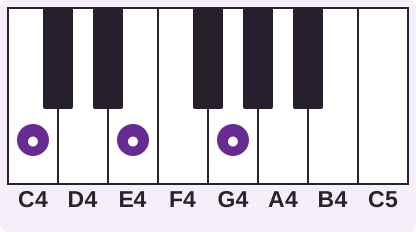
Find middle C, labeled C4 in these diagrams. Play C4, E4 and G4 together with your right hand. Read the notes from lowest to highest, left to right. The purple circles show the keys to press; the note labels underneath identify their exact octaves.
Now move to F4, A4 and C5. This is F major in root position, with F as the lowest note. It is a perfectly usable sound, but all three notes have moved up. If you follow the bottom, middle and top notes as separate lines, you get C4 to F4, E4 to A4, and G4 to C5.
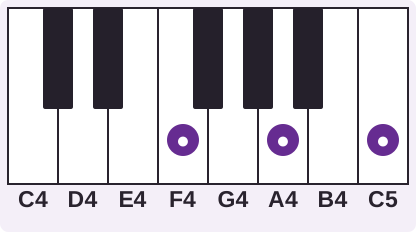
Play those two shapes back and forth without the sustain pedal. Keep the volume and rhythm similar so you can hear the effect of the change in register. There is nothing wrong with the lift; it may be exactly what a chorus needs. For a quieter accompaniment, though, we can try a smaller movement.
Keep C4 and move only two notes
Return to C4–E4–G4. This time, leave C4 where it is, move E4 up to F4, and move G4 up to A4. Your next chord is C4, F4 and A4.
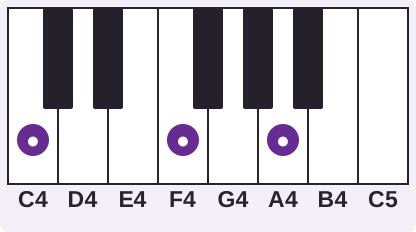
The bottom note has stayed still, the middle note has moved up a half step, and the top note has moved up a whole step. Your hand no longer needs to shift the entire shape to a new part of the keyboard. Listen to the upper line in particular: G4 now rises to A4 rather than jumping to C5.
Both F voicings contain the notes F, A and C. C4–F4–A4 is an F-major triad in second inversion because its fifth, C, is the lowest note. Played on its own, it can be written F/C. It is not a C-major chord: the E and G of the starting C chord have become F and A. We have kept the progression C major to F major while choosing a different inversion for F.
For this first comparison, use the right hand alone. If you later add a lower F in the left hand, F becomes the bass of the complete texture. The right hand still plays C–F–A, but the complete chord is no longer an F/C bass arrangement. Keep that distinction in mind when reading slash chords on a chart.
What is the difference between a voicing and voice leading?
A voicing is the way you arrange a chord's notes: which note is lowest, which is highest, how far apart they sit, and whether you double any of them. An inversion tells you which chord tone is lowest. Voice leading describes the movement between voicings, so you have to hear at least two chords to judge it.
In our closer C-to-F change, C4 is a common tone, a note shared by both chords. Keeping it at the same pitch helps connect the sounds. Sharing a note name is not quite the same as holding the same key: moving C4 to C5 would still be a jump of an octave.
You do not have to keep every common tone or always choose the closest note. Those are useful options to test, not rules that determine what a song should sound like. A melody, a written bass line, or the energy of a section may give you a better reason to move farther.
Practice the change without hiding the gap
Start slowly enough that you can find the F and A before you need them. Try C4–E4–G4 for four steady counts, then C4–F4–A4 for four counts. Keep C4 held across that first change if it feels comfortable, while the upper two notes move. For this right-hand exercise, 1–3–5 on both shapes is one option, not a requirement; use a comfortable fingering and do not force a stretch.
Then practice the return. C4 stays, F4 moves down to E4, and A4 moves down to G4. If the change is uneven, play just E4–G4 moving to F4–A4 a few times before putting C4 back underneath. That isolates the part your hand actually needs to learn.
Once you can alternate without stopping, play each chord again on beat one of its bar. Record a short pass with the larger F4–A4–C5 voicing, followed by a pass with C4–F4–A4. Use the same tempo and touch. The comparison should tell you which version supports the phrase, rather than merely which shape is easier to reach.
Add a little sustain pedal only after you can hear a clean change without it. Release and renew the pedal as the harmony changes so the old E and G do not blur into the new F and A. Pedal can connect a phrase, but it can also hide the movement you are trying to hear.
Use the same idea in a song you already play
Choose one awkward chord change in a song, rather than rearranging the whole progression. Write down the notes in each chord, find any shared notes, and try a voicing of the next chord that sits near your current hand position. Check that you have kept the intended chord tones rather than accidentally replacing the chord.
Then sing or play the melody over that choice. A closer accompaniment may make the phrase flow, but a new top note can also compete with the tune. If a bass player is already supplying the roots, your right hand has different options than it would when you are accompanying yourself alone. Start with the small movement, then judge it in the full musical setting.
If identifying chord tones is the difficult part, my guide to beginner music theory for adults explains how theory can connect to what you play. If you are developing your own progression, you can also use it in the voice-memo-to-song exercise.
Keep the two short recordings from the exercise and listen to them with the melody in mind. If you're unsure which voicing fits, bring both versions and the song to a lesson. We can listen to the top note, the bass, and the movement that interrupts the phrase before settling on a hand shape. You can explore piano lessons or book the $20, 30-minute intro, credited toward your first month if you continue. The aim is to hear what each note contributes, so you can choose a movement that belongs in your song.